
How Columbus Arrest Records Work
Columbus anchors Bartholomew County as its seat. The 2020 census put the city at 50,474 people. Patrol work falls largely to the Columbus Police Department. It is hardly alone, though. The Bartholomew County Sheriff's Office, Indiana State Police, and joint units can all make arrests, so one case may scatter paperwork across several offices. Each agency keeps its own incident or case report. The jail holds the booking record. It also holds the intake photograph taken when someone is admitted.
Most CPD arrests end at Bartholomew County Jail. Not always. A citation, a juvenile matter, a medical need, a transfer, or another holding authority can send a case down a different path entirely. A CPD contact, in short, does not guarantee a county jail booking exists.
Where Columbus Busted Mugshots Appear
There is no single official Columbus mugshot search. CPD has no daily arrest log, fixed-window blotter, booking feed, or photo gallery. Bartholomew County also publishes no web roster. The channels below serve distinct purposes, so start with the official source that matches the question.
| Channel | Photos? | Status | Best use |
|---|---|---|---|
| CPD newsroom | Sometimes | Official, selective | Notable incidents and agency releases |
| Bartholomew County Jail phone line | No phone display | Official | Current custody confirmation |
| CPD Records Division | By specific request | Official | City reports, police photos, and video |
| BCSO record request | By specific request | Official | Booking sheet or named jail photo |
| Indiana MyCase | Generally no booking photo | Official court portal | Filed case events and later disposition |
| The Republic and local radio | Varies | Independent news | Context on selected events, not a complete roll |
| Mugshots.com county archive | Often absent | Unofficial and stale | Historical fragment only, never current custody |
The order matters. Official agency and court sources should lead. A news report may help identify an incident date, while an unofficial listing may be old, incomplete, or detached from the court outcome. Absence from any of these sites does not show that no arrest occurred.
Busted in Columbus: Lookup Steps
A useful search separates present custody from the older arrest file. Bartholomew County’s jail page sends callers to 812-379-1750, option 2, for current inmate information. The county FAQ also publishes 812-379-1753. Neither number is a historical arrest database, and neither call guarantees release of a booking photograph.
- Start with the person’s legal name and an approximate incident or booking date.
- Check the CPD newsroom if the event may have been selected for an official release.
- Call the jail’s designated line to ask about current Bartholomew County custody.
- Ask CPD for the city report or police-held image, and ask BCSO for the booking sheet or intake photo.
- Search MyCase after filing, then confirm the disposition with the Bartholomew County Clerk when an official court document is needed.
A released person will no longer be confirmed as currently jailed, but that does not mean the underlying booking record vanished. A person sentenced to state prison belongs in the Indiana Department of Correction Offender Locator rather than the county jail channel. Federal or immigration custody also uses separate federal systems. The Bartholomew County booking guide explains those county, state, and federal custody paths in full.
Columbus Police Arrest Record Requests
CPD’s Records Division is the direct city source for public police reports and department-held photographs. Its official page links separate Report Request and Photo Request options. Requests may be sent to records@columbus.in.gov, mailed, or delivered in person. Give the report number when known. Otherwise provide the incident date, location, and involved person’s name and date of birth so staff can identify the record without guesswork.
Public reports are generally available two business days after an incident. That is an availability guide, not a promise that every record or image can be released. Indiana’s Access to Public Records Act permits agencies to withhold or redact protected material. Investigatory, juvenile, sealed, medical, and confidential details can receive different treatment. CPD states a $5 fee for a State Accident Report, but the research found no published general arrest-report or police-photo price. Do not apply that accident-report fee to other records.
Columbus Police Records Division
Address: 123 Washington Street, Columbus, IN 47201
Records: 812-376-2653
Front desk: 812-376-2600
Dispatch: 812-379-1689
Hours: Monday through Friday, 8 a.m. to 5 p.m., excluding holidays
CPD and BCSO do not hold the same item. Ask CPD for the incident report or a city police image. Ask the sheriff’s office for the county jail booking sheet or intake photograph. BCSO says charges may apply but does not publish a fixed booking-photo fee, so let the agency quote the actual cost.
The official CPD Records page shows the report and photograph request paths.
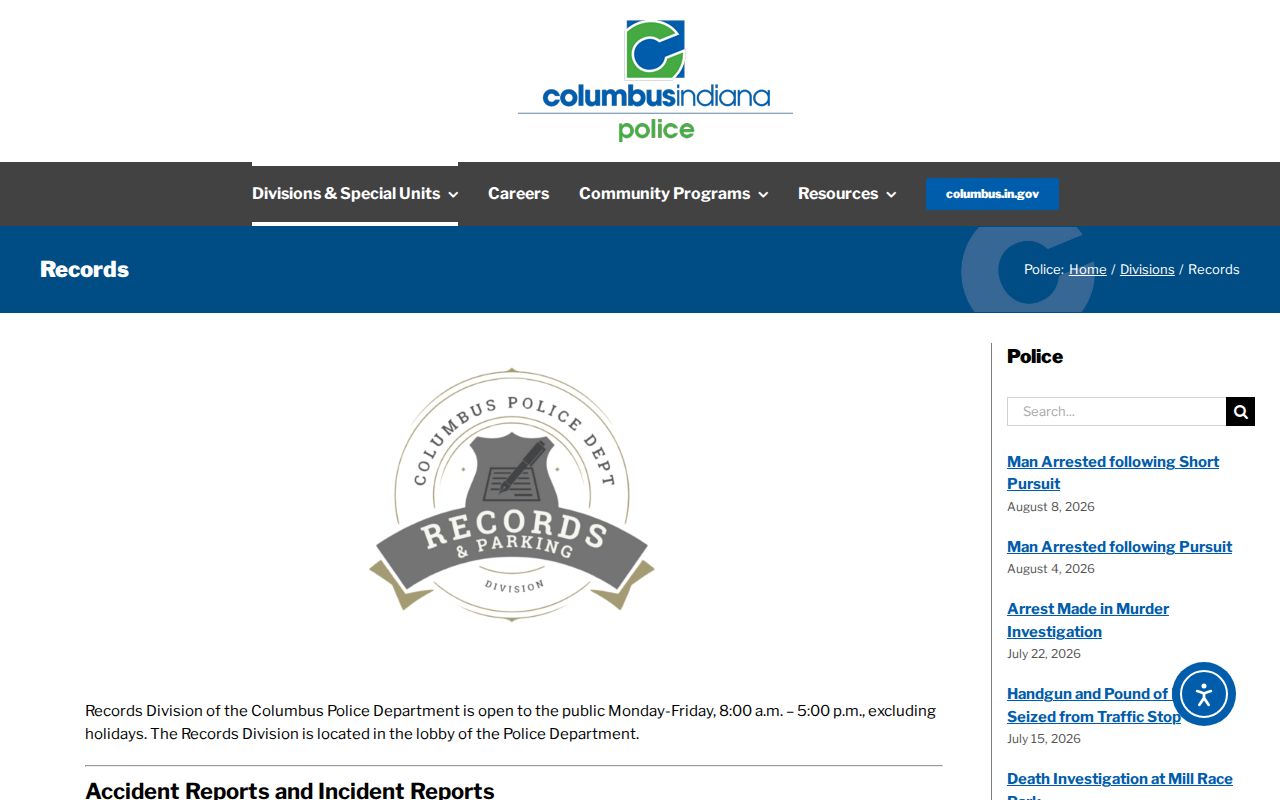
This interface is the city-specific route for a known Columbus police event, while the sheriff remains the custodian for the county jail booking image.
CPD Releases Are Selective
CPD's newsroom helps, but it isn't an arrest log. The department picks which incidents to announce. A release might include a photo of a named person, an evidence image, the jail where someone was taken, or basic case facts. Posting is event-driven. There's no schedule, no fixed window, and no promise that every arrest gets a mention. That matters when you're checking who got busted in Columbus. Silence from the newsroom tells you nothing about other arrests. It only proves what the department chose to share. For anything beyond that, go to the source that holds the paper. The police report may carry more detail, the jail can confirm current custody, and the court file shows what happened after prosecutors acted. The official Columbus Police newsroom shows how selective this publishing approach works in practice.

The page can flag a notable local incident. It is not a complete roster of Columbus bookings, though, and should never be read as one.
Columbus Arrests Through JNET
Columbus cases can involve more than CPD. The Joint Narcotics Enforcement Team brings together city police, the sheriff’s office, and the prosecutor in multi-agency work. Indiana State Police may also take part in a local investigation. As a result, the same arrest can generate a CPD release, a sheriff or prosecutor account, and several news stories that all trace back to one operation.
Those repeated accounts are not always independent proof. Compare the agency named in each story, the incident date, and the allegations. Then use the custodian that created the needed record. The investigating agency is the logical source for its report, BCSO maintains the jail intake file, and the court clerk maintains the official filed case. This agency split is one of the most useful facts when a broad Columbus mugshot search produces mismatched or duplicate results.
Columbus Busted Mugshots in News
The Republic is the strongest newspaper source for Columbus and Bartholomew County. Its local section follows selected arrests, warrants, court events, crashes, and multi-agency cases. WCSI posts frequent short reports drawn from CPD, BCSO, Indiana State Police, JNET, and prosecutors. WKKG often mirrors the WCSI feed. Identical wording there should not count as separate confirmation. Regional WBIW sometimes republishes major Columbus releases.
Photos vary a lot. A story might show a CPD-supplied image of a person, evidence, a scene, an agency logo, or staff photography. None of that makes the news stream a booking roster. Coverage can be delayed, edited, or limited to whatever the outlet finds noteworthy. The county's broader Arrest News page explains how to move from a headline to the official record.
Third-party booking sites come after these channels. Busted Newspaper, RecentlyBooked.com, Arrests.org, and Mugshots.zone have no confirmed Bartholomew County section. Mugshots.com holds the only confirmed county archive. It contains just 16 entries grouped under 2013, many marked "No Mugshot Available." That fragment proves nothing about current custody or recent activity. Verify any old listing through the court and the agency holding the record.
After a Columbus Booking
A booking and a court outcome are two different animals. Booking is simply what happens at the Bartholomew County Jail. Staff log the person's identity, the arrival time, the arresting agency, and the charges on the paperwork. Indiana also requires an intake photo at this stage. Court stages come later and answer other questions. Arraignment covers the charge and the defendant's rights. Bond sets release terms while the case moves forward. The disposition is how it all ends, whether by dismissal, plea, or judgment.
To track a public Indiana case, search MyCase by name or case number. The portal itself warns it is not the official court record. Need something certified or complete? The Bartholomew County Clerk is the right office to ask. Juvenile, sealed, and confidential files will not travel the same public path. If the person has moved from the county jail into an IDOC prison, the state's offender search is the tool to use. For someone already released, file a records request rather than expecting a live custody answer.
One caution about old news. Keep the incident date, booking date, publication date, and disposition date separate from each other. That habit stops a recycled Columbus busted mugshot from being mistaken for a fresh arrest.